Love the Lord your God, listen to His voice and hold fast to Him, for the Lord is your life! Deut. 30:20


Tuesday, April 9, 2013

Caeserea

Our bus drove us to Caesarea Maritime.

King Herod built Caesarea as a luxurious city, carefully planned city laid out on a grid Greco-Roman style.  It had paved streets and monuments such as temples, a Palace, public baths and entertainment sites. Caesarea's strategic location placed it at the juncture of important trade routes.  The harbour offered no natural advantages as the currents were dangerous and there were problems with silting.  Using ingenious technical advances, Herod's engineers constructed two huge breakwaters, lined with warehouses.  At the end of the breakwater stood a lighthouse, whose fires burned 24 hours a day.  Six enormous bronze statutes marked treacherous sandbars.  To ships coming in from the sea, the sight must have been truly impressive.

The wealth of Roman Caesarea is reflected through the wide range of stone particular to the Roman building style.  Marble and granite were brought from all over the Mediterranean and Eastern coasts and especially from the famous quarries of Greece, Turkey and Egypt.


The theatre offered seating for more than 10,000.


As we walked by the theatre on our way to this area below for our lesson time, we passed a group of Asians singing "Amazing Grace".  Very worshipful and touching! 
 Later on, an Asian girl was passing our little group and she stopped to ask me in halting English what we were doing.  I showed her our syllabus "Exploring Bible Times:  Field Notes" and mentioned that we were doing a Biblical studies tour.  She gave me a big smile.  "I am a Christian too.  I am from China!"  We hugged each other.  "We are sisters" I told her.  "Yes!  Sisters!"  We both had tears in our eyes.  Someday I will ask her her story!


Jutting into the sea are the excavated remains of an impressive palace with a pool in its western section.


Just think!  Paul was right here, in this court, appealing to Caesar!!  (Acts 25:11)  He lived under house arrest in Caesarea for 2 years.  To the Romans, the idea of people believing in a Messiah was to them a political coup.  Christians were considered traitors to Rome.  Paul would argue that Christians were not traitors and no threat.

Caesarea was home to Cornelius in whose house Peter first preached to the Gentiles.  It was the place of residence of Philip, the evangelist.  Later, Peter was rescued by the prayers of the people in this city.  

James was beheaded here.

A riot incited the outbreak of the first Jewish revolt against Rome.  So much history!

King Herod's Hippodrome - This edifice, whose location perfectly matches Josephus' description, was built for the inauguration of the city in 10/9 BC.  This hippodrome was the venue for the Action Games instituted by King Herod in honor of the Roman emperor Augustus.  The games were held every four years, and included horse and chariot races, athletics, gladiatorial combat and hunting.


Beautiful mosaic flooring in the hot tub.


A bride and groom were having their pictures taken.


A shirt for sale in the gift shop.

In the 9th century (Arab period), a fortified city surrounded the harbour, with high walls and dry moat.

The Roman aqueducts - Since Caesarea had no rivers or springs, drinking water for the Roman and Byzantine city was brought via a water aqueduct, bringing fresh water from Mt. Carmel, an elaborate water and sewer system.


Following the Arab conquest in 640, Caesarea lost its political and economic significance.  Most of its citizens left the city and it became a forsaken village.  In the 9th century, with the development of sea-trade and the recovery of coastal cities, Caesarea was refortified.  It was conquered by the Crusaders in 1101 and ruled by the Knights of Garnier.  It was again destroyed and rebuilt.  Later Bosnian refugees settled here.  In recent years, new residential areas were built in the vicinity.  Caesarea is now a national park.  Excavations are still underway.

Monday, April 8, 2013

Ephraim

Jesus therefore walked no more openly among the Jews, but departed from there into the country near the wilderness, to a city called Ephraim. He stayed there with his disciples.  John 11:54

Today, Ephraim is called Taybeh (spelled different ways).  After our time learning about shepherding, we went to this town that is mainly Arab Christian.  There is no mosque located here at all.


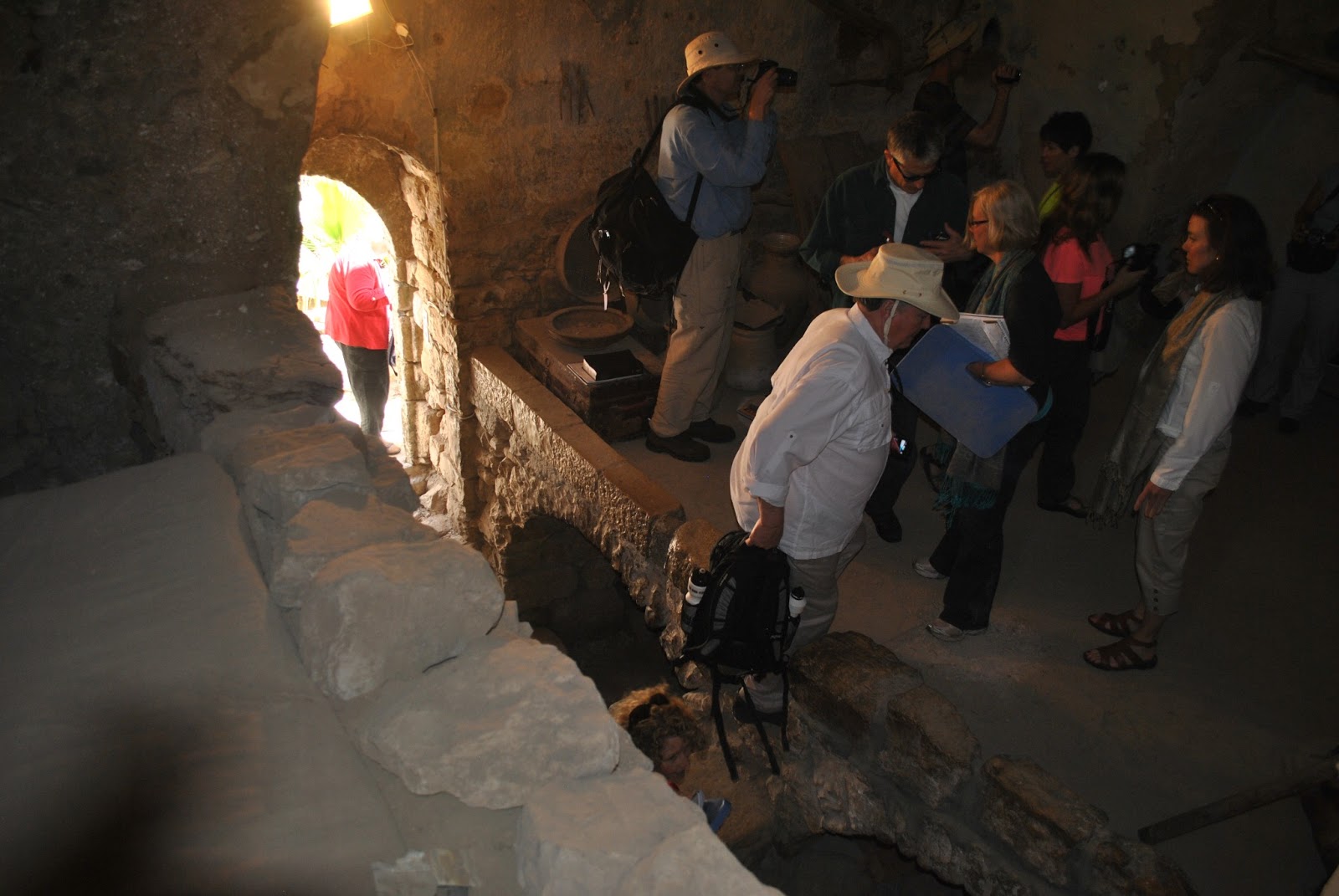
There is a 1st century house in this town that we were able to see.

 Jim told us that this home was probably similar to a home Mary and Joseph would have lived in.

 The main living area of this style house was built over a cave (basement) that held livestock.  When you entered this home, the livestock area is to the left.


An animal feeding trough, not the guest room, welcomed our King.


You have to climb a few steps up to the living room.

 Grain was kept in the wall.  You would pull out a plug and grain would fall into these holes.
 Behind the wall and up a few steps was the "kataluma" or guest room.
 Al taking a few notes outside of the church at this town.


We were able to use the restrooms by the church.

We found out that in most places, you cannot flush the paper.  You must put it in the trash can.

After our restroom break, we went on to Caesarea-Maritime.

Sunday, April 7, 2013

Israel trip - Shepherds

I have always loved the image of the Good Shepherd.

"He tends His flock like a shepherd:
He gathers the lambs in His arms
and carries them close to His heart;
He gently leads those that have young."
Isaiah 40:11


Allen's grandmother gave me this old painting.

"I am the Good Shepherd; I know My sheep and My sheep know Me."  John 10:14                                  


As we left Jerusalem, we came upon this field with sheep grazing in it.


 There was a flock of goats in another field. 
 "He will separate the people one from another as a shepherd separates the sheep from the goats."  Matthew 25:32

Our bus driver parked the bus and we got out and walked to look over the field.  


The shepherds came to see what was going on.
While our driver visited with the shepherds, Jim spoke to us about sheep.

This is a sheep fold.  The sheep are placed here overnight to protect them.  In the Biblical times, there were leopards, bears, wolves and lions in the land.

 Jim B. sits in the "gate" of the sheepfold.   

"The man who enters by the gate is the shepherd of his sheep.  The watchman opens the gate for him, and the sheep listen to his voice.  He calls his own sheep by name and leads them out.  When he has brought out all his own, he goes on ahead of them, and his sheep follow him because they know his voice."  John 10:2-4

"Jesus said again, 'I tell you the truth, I am the gate for the sheep....I am the gate; whoever enters through me will be saved." John 10:7,9


 The donkey keeps the herd calm.


We came across many shepherds while we visited Israel.  The Bedouin live in shacks, but we were told that they are really quite wealthy people.
Little children are taught how to take care of the sheep.  As each sheep can cost $500-$600 each, the children first tend their flock close to home.

As they become more responsible, they are then able to take the herd further away from home.

My friend, Joyce, gave me the painting below.

I love that He is a Rescuer.


"I am the good shepherd. The good shepherd lays down his life for his sheep." John 10:11


 I could not resist purchasing the shepherd with lamb olive wood figurine to bring back with me to put beside the photo of my "little lambs".